August 26: Sharp Park to Downtown Jackson

Joe Writes . . . 

Pain in the rump.

Class-A Deadfall outside of Jackson: no getting over this one.

We canoed for 5 hours yesterday and never saw another soul out on the water, at least not until we woke a homeless guy sleeping under a bridge as we approached downtown Jackson.  I’m pretty sure I know why we had the river to ourselves: this trip was damn hard work!  I’m glad I’ve gotten in better shape during the past year or so – I dropped 40 pounds and started exercising 2 or 3 times per week – because otherwise I might have been reluctant to attempt the journey we made from Ella Sharp Park to downtown Jackson.

The difficulties we encountered consisted of deadfall – trees fallen across the river – and shallow water where we bottomed out and had to exit the canoe.  We approach deadfalls slowly; more often than not a tortured pathway through reveals itself and we are able to make our way through the obstacle without exiting the canoe.  These are your average ‘Class C’ deadfalls (I am making this classification system up on the fly).  Class B deadfalls require that we get into the river and pull the canoe up and over the obstruction, and there were several of these yesterday, too.

Most daunting of all are Class A deadfalls, requiring us to pull the Billie V (‘V’ is an initial, not a Roman numeral) out of the river and carry (portage) her and all her contents around the obstacle.  We ran into two of these yesterday.  After we got around the first I swamped the canoe while getting back in, sending both of us and all our gear into the river.  It was bound to happen eventually, I suppose.  Canoes are, by their very nature, unstable and it’s not as if we were able to search out flat easy river bank for taking out or getting back in.  You take what the river gives you; there’s no debating with her*.

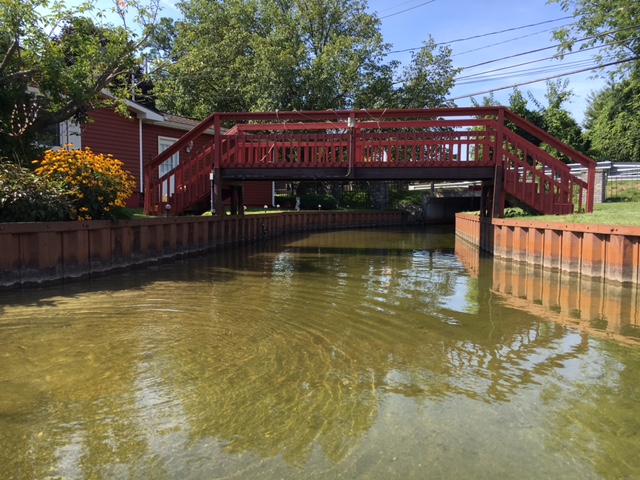
The second Class A deadfall was just as we approached downtown Jackson.  This area presented a rather difficult portage in a somewhat desolate setting, and made me think how nice it would be if the river were largely clear so that residents could more easily enjoy its charms.  In fact, what if our rivers were treated like parks and maintained for the betterment of the river, the enjoyment of the citizenry and the overall health of the planet?

Downtown Jackson was very nice and appeared to have a lot of positive things going on: we saw a small but bountiful Farmers Market that operates three days per week through early November http://www.jacksondda.org/farmers-market/; had lunch at the Grand River Brewery, a spot we both liked a lot http://www.grandriverbrewery.com/ and where I discovered Brix Soda Company’s delicious root beer http://brixsodacompany.com/.  We would have stopped to look at the gorgeously-restored cars on display had we not been so tired, late and dirty http://www.jacksondda.org/event/cruise-in-4/.

The Grand is a resource Jackson could certainly display and exploit to better advantage.  In downtown Jackson the Grand runs through a spillway and the only vegetation on the banks are weeds fighting their way up through the cracks in rough-poured concrete river banks.  Imagine a river walk in Jackson and a hip retail environment built around a restored river running through the center of town.  It’s a blank canvas right now with limitless possibilities, an exciting time to be in Jackson.

Jackson is by no means the only city which has yet to take advantage of the opportunities presented by a river; Ann Arbor has been talking about opening up river views and access in the North Main Street area for decades, and Detroit has only recently begun to capitalize its riverfront.  Two cities which come to mind as having taken advantage of their riverfront assets are Windsor, Ontario, Canada and Grand Haven here in Michigan.  I’m looking forward to testing the river in Eaton Rapids next year and it will be fun to see what other cities along the Grand have done as well: http://lansingjournal.mi.newsmemory.com/publink.php?shareid=1f038eb8f

*Tom and I discussed whether the Grand is male or female.  Brief research shows that rivers can be either and that the Grand’s gender is not firmly established.  This is a topic for another time, but for now I have decided the river is feminine.

Tom Writes . . . 

IMG_2751

Untying the ‘Jesus Knot’ which holds the canoe to Joe’s truck, preparing to put in on Aug 26th.

Next Leg along the Grand River

IMG_2755

Our put-in at Ella Sharp Park, just downstream from the Probert Rd bridge.

We put the Billie V. in where we left off last time. That is at the park, right at the Jackson city limit. But, the river is crooked, and we had to paddle east, away from Jackson, away from our ultimate northwest goal. Then back west, to make up for the darn river’s actual course.

Today, we had a long paddle, about five or six hours, when everybody had told us it would take three hours. Oy!

We ended our trip at the Grand River Brewery in Jackson. GRB is a nifty saloon with good food. They also distill their own booze. And they have close affiliation with a couple Michigan wineries, and, as I said, good food. House-made sausages, soft pretzels, Mediterranean pizza, good beer and root beer for us. They took us as customers despite the river mud all over our legs and posteriors.

Joe and I have been somewhat arrogant.  We believed we already had paddled past the shallow parts of the river, and the river blockages. Wrong! Today, we encountered two total blockages, where we had to pull out the boat and drag it around on land. And, we had at least half a dozen instances of low water to the point where we got out of the canoe and towed it to deeper water.

Info for the people who clear out the Grand River: There is a giant tree just upstream of the Probert Bridge, and a huge log jam just downstream from the Jackson Lions Park Bridge. Joe and I will help you clear these, but they are too much for a couple amateurs. We cannot do it on our own.

The Jackson Parks Department or the State of Mich. maybe should take care of these things. These things would be great summer jobs for American high school guys.

And!  Joe and I had our first canoe tip-over today! Details are sort of hilarious. Will explain later.

We would love to hear from any who may stumble across this blog: Tom Neely can be reached at timbuktom1@gmail.com; Joe Neely can be reached at joeneely55@gmail.com. If you have a kayak or canoe we would love to have your join us for a day. We have been basing our trips on the routes laid out by the Grand River Environmental Action Team, which can be see here: http://great-mi.org/trail_maps2.htm. Our plan is to complete all these Jackson-area trips before the onset of cold weather.



Posted in Grand River, Uncategorized | Tagged , , , , , , , | 2 Comments

August 19, 2016: Approaching Jackson

Tom writes . . . 

We made it from Vandercook Lake all the way to the city limit of the city of Jackson, Michigan. The river flows generally northward in this section, but still is very twisty. The river is wider here, at least fifty feet (16 meters) wide, most of the way, with some wider pools and only a few narrow spots. It is deeper, easier to float on, with fewer obstructions than in upstream sections.

This is the south central part of Michigan. It is not a famous place. Northern Michigan, “Up North,” is well known for its natural beauty; our Great Lakes shorelines are big-time tourist destinations; Detroit is famous and infamous for many reasons. But, nobody ever talks much about this south central part of the state.

Joe and I have found it to be a lovely area. The river is clear and clean. We paddled through three sparkling fresh lakes. We saw deer. We were NOT pestered by mosquitoes. Along our route, utterly wild sections alternated with areas of very nice homes. And, the sunny August weather was glorious.

Michigan is in the northern tier of US states. In the winter, we get lots of snow. If you have not been here, you may believe Michigan is a cold place. But, no! The climate here between June and October is perfect, especially perfect if you can get out on the water. And, we have lots of water here. And, that is exactly what Joe and I have been doing: spending days on the water under the perfect sun, in the perfect summer breezes, with our shirts off.

Our next leg will be the first urban section of our trip, right through downtown Jackson. So far, this Jackson area seems great. I hope we will find a riverside tavern or a bistro right in downtown Jackson, and a place to pull out the boat so that we can stop and buy lunch and celebrate.

Editor’s (i.e.; Joe’s) Note: Tom takes his shirt off; I do not. He weighs about 185, I weigh closer to 210.  Enough said.  We would love to hear from any who may stumble across this blog: Tom Neely can be reached at timbuktom1@gmail.com; Joe Neely can be reached at joeneely55@gmail.com. If you have a kayak or canoe we would love to have your join us for a day. We have been basing our trips on the routes laid out by the Grand River Environmental Action Team, which can be see here: http://great-mi.org/trail_maps2.htm. Our plan is to complete all these Jackson-area trips before the onset of cold weather.

Posted in Grand River, Uncategorized | Tagged , , , , | Leave a comment

August 19, largely photos

Vandercook Lake to Ella Sharp Park

Joe writes . . . 

There is water in the river as a result of 5″ of rain a few days ago.  This was a nice stretch because we had some open water paddling across three lakes in Jackson County (Vandercook, Brown’s and Williams) and the river had a bit more current than our last trip so it felt as if we were, indeed, going downstream at times.  Never bottomed out once today.

IMG_2684.JPG

The Grand flows through Vandercook Lake, lots of nice homes here.

IMG_2688.JPG

From Vandercook one goes under this small bridge and into Brown’s Lake to stay on the Grand. Note the clear, clean water here.

IMG_2690.JPG

Looking back across Brown’s Lake, just before the river goes on to Williams Lake. Clean water, very swimmable.

IMG_2692.JPG

There are two log homes near the point where the Grand continues on from Brown’s Lake and towards Williams Lake, this being one.  A beautiful spot.

IMG_2713.JPG

The first real ‘river’ scenery of the day as we leave Brown’s Lake, note there’s even a bit of a current in the water.

IMG_2716.JPG

It’s as if the Grand is laying a path for us here, between Brown’s Lake and Williams Lake.

Questions or comments? We would love to hear from you!

joeneely55@gmail.com

timbuktom1@gmail.com

Got a canoe or kayak?  Join us for a few hours some day!


Posted in Grand River | Tagged , , , , , , , | Leave a comment

August 7, 2016: Starting Down the Grand

TOM WRITES . . . 

Joe and I met at a very nice place, Vandercook Lake, south of Jackson, Michigan. And then we drove to a place that is not really even a place, just a little bridge on a road called Loomis Road, to put our boat into the river. There was a spot to park the truck, and a way to drag the boat down to the water. We left a note on the truck’s dashboard: “Paddling. Back soon. Sat. Aug. 6.” Locked the truck and set off.

The river (“river”) is about twenty feet (six meters) wide at this point. And about eight inches deep, maybe a foot deep. (That is about 30 centimeters.) The river bottom is sandy, partly. The river banks are sticky black mucky mud. One can (I did) step on the black muck and have one’s (my) foot sink deeper into the muck than the river is deep.

The river banks have trees, maple, oak, a few pines, on both sides, filtering the sunshine and the breeze. A Great Blue Heron flew ahead of us downriver. We saw a Kingfisher, Redwing Blackbirds, swallows catching bugs, maybe an Eagle, and Hawks. One of the soaring hawks had prey in its talons, some not-very-small mammal. Bigger than a chipmunk or a mouse, smaller than a raccoon or skunk, not a squirrel, because no long tail. We heard high-pitched screeching from above. Thought it might be the not-yet-dead mammal. But realized it was the hawk. Hawks have rather disappointing voices. Squeaky, not commanding.

We saw lovely yellow and black Tiger Swallowtail butterflies. They seem to like to land on the river bank mud in groups of three.

We encountered many herds or flocks of waterbugs, bugs that walked on the water. I started calling them Dolphin Bugs, because they ran ahead of our bow when we paddled through them, sort of like dolphins do, when they play at the bows of boats at sea.

This stretch of the Grand River is the Kingdom of Dragonflies. Honestly, at least a dozen different types and sizes of Dragonflies. One lovely type with emerald green body and black wings caught my fancy. Turtles as well. No big Snappers. Just small turtles that plopped into the water when we approached.

The river banks have trees. Some of the trees have fallen down across the river. Some of the fallen trees are high enough off the river that we could hunker down and paddle under them. But, three times, we had to get out of the canoe, clamber over the fallen trees, and pull the canoe itself over.

Other times, maybe about eight times, we had to get out of the canoe, and pull it through shallow water stretches. When we both sit in the canoe, it only needs about six inches of water depth, but there were times when the water was shallower.

Lovely sunny day, wild country around us, met a few kayak paddlers, heading upstream, saw very few houses along the way. The breeze was in our faces when we got to Vandercook Lake. Had to paddle into the breeze for the last quarter mile. No big deal.

We had black mud all over us and in the boat at the end. No big deal. We washed out the boat and took a dip. Next leg goes north from Vandercook.

JOE WRITES . . . 

On August 6 we made our second journey in Jackson County, putting in at the point where Loomis Rd crosses the Grand in Liberty Township and paddling to Vandercook Lake in Summit Township.  We covered about 6 miles in 4.5 hours.

It was a spectacular summer day but seasonal shallow water – exacerbated this year, I suspect, by drought conditions – and trees which had fallen into and across the the river resulted in less-than-ideal canoeing conditions.  The Grand is narrow here, seeming all the more so to such as us who grew up watching Great Lakes freighters and big cabin cruisers ply the river’s mouth in Grand Haven.  Here the river is 15 – 20 feet wide for much of our trip; a good high school long jumper could sail over the river in many spots if he or she had solid footing for the take-off.

On three occasions we had to get out of the canoe and lift/pull it over trees that had fallen across the width of the river, completely blocking our progress.  There were three or four other spots where less-determined voyagers would have done so again but we sat on the floor of the Billie V. and pulled her through the tangle of branches until we emerged on the other side.  On at least a dozen occasions we bottomed out in the shallow water and one or both of us got out and pulled – sort of like a mule on the banks of the Erie Canal, if I remember my elementary school history lessons correctly – until we found water deep enough to paddle in again.  The water was refreshing – 70 degrees, perhaps a bit warmer – and had we encountered a deep swimming hole it would have made for perfect swimming.

Tom and I discussed, among other things, which rock and roll songs we thought achieved true greatness, which deserved to be at the very top of the pantheon.  Tom says “Layla” is number one; a worthy choice.  I advocated for “Like A Rolling Stone.”  We both agreed that the Kingsmen’s “Louie Louie” deserved the no. 10 rating I recall from some influential top-100 list a few years back and also agreed that “Satisfaction”, while an important song, has no business being ranked at no. 1 as it so often is.

For the umpteenth time I tried to convince him that “MacArthur’s Park” – written by Jimmy Webb, as recorded by Richard Harris – is, in fact, a great song and not the Worst. Song. Ever. as so many maintain.  Tom wouldn’t buy into greatness but he understands my passion for the song.  I don’t know why I loved that song as much as I did when it was released in 1968; I must have been a very dramatic 13-year-old.

I asked Tom if he could think of any metaphysical aspect (concerned with abstract thought or subjects, as existence, causality, or truth. concerned with first principles and ultimate grounds, as being, time, or substance) of our time on the river this day, anything approaching the profound.  He pointed out that while we were just minutes from civilization we were also quite alone, and that we hadn’t had to work all that hard to escape the hurly burly.  The benefits of and reasons for wanting to escape the hurly burly (a Middle English term we still recognize and use) vary from person to person.  For me, on this day, it meant that I could choose to sing “MacArthur’s Park” aloud without needing to explain myself or apologize.  That freedom can be applied to just about anything – not just singing out loud – and there’s certainly value in that.

Later in the weekend one of my sons – Arkansas son, as opposed to California son -called.  He asked why we had decided to undertake this task of canoeing the length of the Grand River.  Because we can?  Because it’s there?  Because we grew up with the Grand?  Because it’s an adventure at a stage of our lives when adventure is not so common?  Because it’s an escape from the hurly burly?  Because it’s an affordable trip and we can’t afford a European vacation right now?  All of these and more, I suspect; I’ll have to work on this.

(We are grateful to the Grand River Environmental Action Team for the work they do on the river and for the trips they suggest; the route we took this day is trip no. 5 of the 11 trips laid out by here: http://great-mi.org/trail_maps2.htm.)

Posted in Grand River | Tagged , , , , , , , , , , , , , , | Leave a comment

Joe Writes . . .

gr boulder july 24

July 24, 2016

Drenching rain, lightning and thunder almost caused us to give up without getting the bottom of our canoe wet on this first day.  The explorer in each of us could not allow that to happen – our ancestors having sailed the Great Lakes with wooden hulls and canvas sails – so we drove to the Liberty General Store, south of Jackson along the US-127 corridor and as close as we could drive to the source of the Grand River.  The manager of the store had given us permission to leave our vehicles at the store even though the business was closed this Sunday.

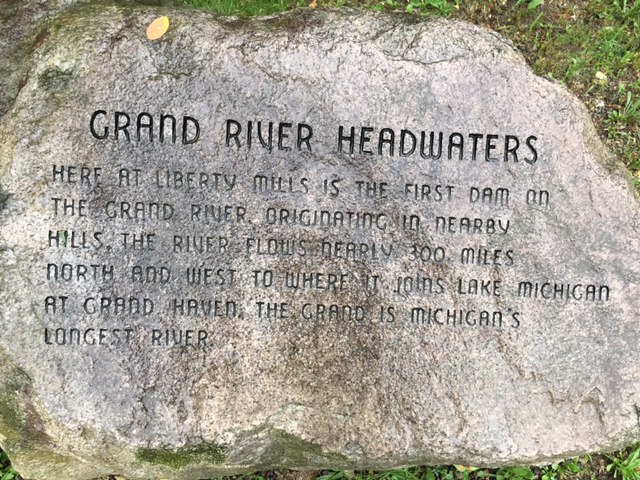
gr headwaters july 24There is a dam at the store, the site of an old mill on the river, and a resultant millpond. From the dam we set out upstream towards Grand Lake, one of two sources of the river.  We would not reach Grand Lake this day due to low water and Giant Bridge Spiders but we got as close to the source as anyone in a canoe could get, which to my way of thinking is damn close.  Perhaps we’ll go all the way to the source on a day when the sun is shining, the water higher, and the spiders less voracious.
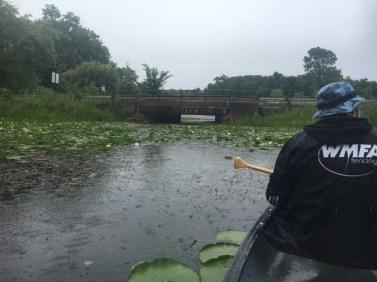
The first portion of the millpond was relatively free of lily pads, offering an easy paddle to gr spider bridge july 24a low bridge, so low that we at first wondered whether we would be able to make ourselves small enough to glide underneath.  We bent low at the waist and used our hands to pull ourselves under the bridge.  It was at this point that I noticed huge spiders dangling from webs with strands as thick as the rope we used to tie our canoe to my truck.  These Giant Grand River Bridge Spiders – for such would my research later reveal them to be, Pons Araneae Gigundus Flumen – apparently didn’t notice us until we were halfway under the bridge, at which time they began – in unison – scurrying towards us in from all directions.
“Duck your head!” I screamed to my brother, then grabbed the bridge’s clammy undergirding and pulled as hard as I could, sending our canoe roaring out of the darkness and into the next pond.  If you’ve never heard spiders scream in anger and frustration . . . well . . . it’s is a sound you’ll not forget.  Trust me.

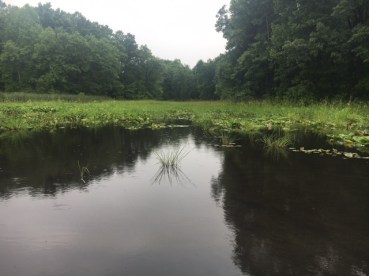
We now entered the first of two connected but distinct ponds, both choked with lily pads.  It was a bit spooky as we paddled forward, the lily pads seeming to grasp at our canoe and the frequent but unidentified sound of numerous large ‘somethings’ belly flopping into the water ahead, bellyflopping always just before we could focus our attention and our eyes to determine precisely what sort of beast was bellyflopping.  Soon there was roiling water at the water line of our canoe.  Muck from the shallow bottom mixed with tepid water, causing the invasive Eurasian Trefoil to fan out and quiver enticingly.  Had I been in the Everglades I would have suspected angry alligators or playful manatees, but we were at the headwaters of the Michigan’s Grand River.

River nymphs?  Dragons?  Only an impression of flame – sensed rather than seen out of the corner of one eye – confirmed the latter.  These local dragons are reputed to be more playful than dangerous, and I was able to relax at last and enjoy their company.  Neither my brother nor I had played with dragons in many years.

The river gods used this shortened first day to teach us important lessons.  Tom dropped gr searching 4 wallet 2 july 24
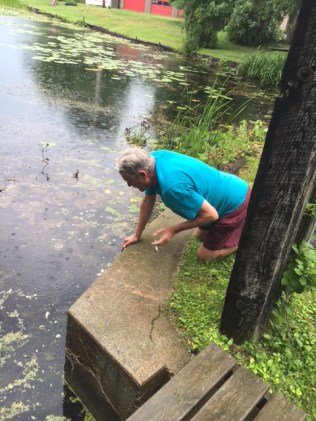
his cell phone in the millpond but retrieved it – in perfect working order, it being sealed plastic bag – after 30 minutes.  We left our paddles and a life jacket on the ground while we drove off to scout future legs of our journey but returned to find all items just as we had left them.  Tom cut his toe in retrieving the phone.  In the future all valuables will be securely zipped into pockets.  In the future we will remember to check for items which, if lost, would leave us stranded.  We will bring a first aid kit, and Tom will not wear open-toed sandals.

No harm done.  Lessons learned.  Onward down the Grand.

Posted in Uncategorized | Leave a comment

Tom Writes . . .

First leg July 24, 2016 – Source of the Grand River (Pretty much)

The Grand River is the longest river in the American state of Michigan. It starts in the middle of Michigan’s Lower Peninsula, and flows north and west, to Lake Michigan.  It enters the lake less than a mile south of my family’s home in Grand Haven, Michigan. My brother Joe and I want to canoe the whole course of the Grand River, paddling downstream, from the source.

I had imagined a sunny summer day on the river, but I woke up at 6 am, and it was raining like Noah. I left my home in West Michigan before 7 am, and the rain never really let up. At the same time, Joe was driving from the eastern side of Michigan, but he did not have rain. The rain was moving from my side of the state toward the place where we were to meet, a little place called Michigan Center.

We met up there in the center. And we scouted the places where we could start to canoe. We wanted to start at “The Source” of the Grand River. However, the Grand River actually has no “Source.” I understand now, why all the famous intrepid nineteenth century British explorers had such a hard time and took so many years to find “The Source of the Nile.” The mighty Nile is just like our nowhere-near-as-mighty Grand River, at its start. No single specific “Source.”

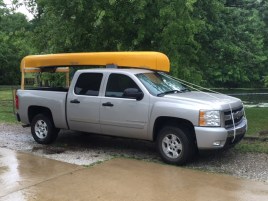
gr truck july 24Canoe trips take a great deal of scouting and arranging. e.g. One needs to find a place to put the canoe into the water, and start. This place might be behind a convenience store, or in somebody’s back yard. There are very few Official Canoe Start Sites. Then, one needs to find a similar place downstream, to stop, and pull the canoe out.

You need to take two cars from the start spot to the gr chase vehicle july 24pull-out spot, and leave one car there. Then, you need to drive back to the start spot in the other car, launch the canoe, and paddle. After hours of paddling, you need to find the pull-out spot as viewed from the river (not always easy). And, then, load up the canoe, and head back to the start spot, to get the first car.  Is that clear? Clear as a muddy river?
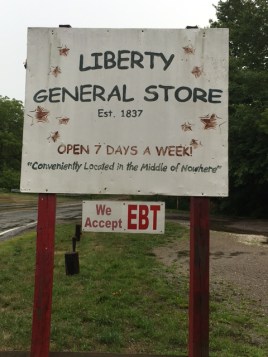


gr store sign july 24Joe and I assessed the weather. Rain and lightning. We assessed a couple of pull-out spots. Dubious. So, we drove to the not-even-a-town of Liberty, Michigan. We put the canoe in at a lake known as the Mill Pond, at the Liberty General Store. We paddled the twisting length of that lake, upstream, until we grounded the canoe out on black silty mucky mud. Impossible to paddle farther upstream. We brought black silty mucky mud up into our beautiful new canoe, on our paddles, just by paddling that far.
The Mill Pond actually is lovely: Mostly covered in water lilies, with white flowers and yellow flowers and lily pads. We saw swans with their swan babies (cygnets?) and kingfishers. We probably were lucky to be there on a cloudy rainy day. I believe that place would be a big mosquito paradise on a regular sunny summer day.

So, we can say we paddled to “The Source of the Grand.” But please google the Liberty General Store. It does not have an actual web site, but if you click on the Google-provided map, it shows the Millpond, and it shows creeks leading farther upstream. I assure you, it is impossible to navigate those creeks. Joe and I really did canoe to “The Source of the Grand.”

We paddled back. In the process of pulling out the canoe, I lost my cell phone down in the mucky lake. Felt and was a fool. But! We got it back, and it still works! Thank you, Poseidon and all river gods and goddesses! I will tell that whole story some other time in some other forum.

Joe made me tie all the knots for holding the canoe onto his truck for the trip home. I worried, but he says they all held.

Posted in Uncategorized | Leave a comment

July 24, 2016: Exploring the Headwaters

Tom Writes . . .

I had imagined a sunny summer day on the river, but I woke up at 6 am, and it was raining like Noah. I left my home in West Michigan before 7 am, and the rain never really let up. At the same time, Joe was driving from the eastern side of Michigan, but he did not have rain. The rain was moving from my side of the state toward the place where we were to meet, a little place called Michigan Center.

We met up there in the center. And we scouted the places where we could start to canoe. We wanted to start at “The Source” of the Grand River. However, the Grand River actually has no “Source.” I understand now, why all the famous intrepid nineteenth century British explorers had such a hard time and took so many years to find “The Source of the Nile.” The mighty Nile is just like our nowhere-near-as-mighty Grand River, at its start. No single specific “Source.”

gr truck july 24Canoe trips take a great deal of scouting and arranging. e.g. One needs to find a place to put the canoe into the water, and start. This place might be behind a convenience store, or in somebody’s back yard. There are very few Official Canoe Start Sites. Then, one needs to find a similar place downstream, to stop, and pull the canoe out.

You need to take two cars from the start spot to the gr chase vehicle july 24pull-out spot, and leave one car there. Then, you need to drive back to the start spot in the other car, launch the canoe, and paddle. After hours of paddling, you need to find the pull-out spot as viewed from the river (not always easy). And, then, load up the canoe, and head back to the start spot, to get the first car.  Is that clear? Clear as a muddy river?


gr store sign july 24Joe and I assessed the weather. Rain and lightning. We assessed a couple of pull-out spots. Dubious. So, we drove to the not-even-a-town of Liberty, Michigan. We put the canoe in at a lake known as the Mill Pond, at the Liberty General Store. We paddled the twisting length of that lake, upstream, until we grounded the canoe out on black silty mucky mud. Impossible to paddle farther upstream. We brought black silty mucky mud up into our beautiful new canoe, on our paddles, just by paddling that far.
The Mill Pond actually is lovely: Mostly covered in water lilies, with white flowers and yellow flowers and lily pads. We saw swans with their swan babies (cygnets?) and kingfishers. We probably were lucky to be there on a cloudy rainy day. I believe that place would be a big mosquito paradise on a regular sunny summer day.

So, we can say we paddled to “The Source of the Grand.” But please google the Liberty General Store. It does not have an actual web site, but if you click on the Google-provided map, it shows the Millpond, and it shows creeks leading farther upstream. I assure you, it is impossible to navigate those creeks. Joe and I really did canoe to “The Source of the Grand.”

We paddled back. In the process of pulling out the canoe, I lost my cell phone down in the mucky lake. Felt and was a fool. But! We got it back, and it still works! Thank you, Poseidon and all river gods and goddesses! I will tell that whole story some other time in some other forum.

Joe made me tie all the knots for holding the canoe onto his truck for the trip home. I worried, but he says they all held.

Joe Writes . . . 

Drenching rain, lightning and thunder almost caused us to give up without getting the bottom of our canoe wet on this first day.  The explorer in each of us could not allow that to happen – our ancestors having sailed the Great Lakes with wooden hulls and canvas sails – so we drove to the Liberty General Store, south of Jackson along the US-127 corridor and as close as we could drive to the source of the Grand River.  The manager of the store had given us permission to leave our vehicles at the store even though the business was closed this Sunday.

There is a dam at the store, the site of an old mill on the river, and a resultant millpond. From the dam we set out upstream towards Grand Lake, one of two sources of the river.  We would not reach Grand Lake this day due to low water and Giant Bridge Spiders but we got as close to the source as anyone in a canoe could get, which to my way of thinking is damn close.  Perhaps we’ll go all the way to the source on a day when the sun is shining, the water higher, and the spiders less voracious.

The first portion of the millpond was relatively free of lily pads, offering an easy paddle to a low bridge, so low that we at first wondered whether we would be able to make ourselves small enough to glide underneath.  We bent low at the waist and used our hands to pull ourselves under the bridge.  It was at this point that I noticed huge spiders dangling from webs with strands as thick as the rope we used to tie our canoe to my truck.  These Giant Grand River Bridge Spiders – for such would my research later reveal them to be, Pons Araneae Gigundus Flumen – apparently didn’t notice us until we were halfway under the bridge, at which time they began – in unison – scurrying towards us in from all directions.

“Duck your head!” I screamed to my brother, then grabbed the bridge’s clammy undergirding and pulled as hard as I could, sending our canoe roaring out of the darkness and into the next pond.  If you’ve never heard spiders scream in anger and frustration . . . well . . . it’s is a sound you’ll not forget.  Trust me.

We now entered the first of two connected but distinct ponds, both choked with lily pads.  It was a bit spooky as we paddled forward, the lily pads seeming to grasp at our canoe and the frequent but unidentified sound of numerous large ‘somethings’ belly flopping into the water up ahead, bellyflopping always just before we could focus our attention and our eyes to determine what it might be.  Soon there was roiling water at the water line of our canoe.  Muck from the shallow bottom mixed with tepid water, causing the invasive Eurasian Trefoil to fan out and quiver enticingly.  Had I been in the Everglades I would have suspected angry alligators or playful manatees, but we were at the headwaters of the Michigan’s Grand River.

River nymphs?  Dragons?  Only an impression of flame – sensed rather than seen out of the corner of one eye – confirmed the latter.  These local dragons are reputed to be more playful than dangerous, and I was able to relax at last and enjoy their company.  Neither my brother nor I had played with dragons in many years.

The river gods, we’re quite sure, used this shortened first day to teach us lessons certain to come in handy on some day and at some place further along in our journey.  Tom dropped his cell phone in the millpond but retrieved it – in perfect working order, it was in a sealed plastic bag – after 30 minutes.  We left our paddles and a life jacket on the ground while we drove off to scout future legs of this journey but returned to find all items just as we had left them.  Tom cut his toe in retrieving the phone.  Lessons learned.  In the future all valuables will be securely zipped into pockets.  In the future we will remember to check for items which, if lost, would leave us stranded, perhaps in a location where it would not be easy to recover from our negligence.  We will bring a first aid kit, and Tom will not wear open-toed sandals.

No harm done, lessons learned, onward.

Posted in Uncategorized | Leave a comment

IF THOSE WHO COULD, WOULD: the soul-nurturing joys of buying locally

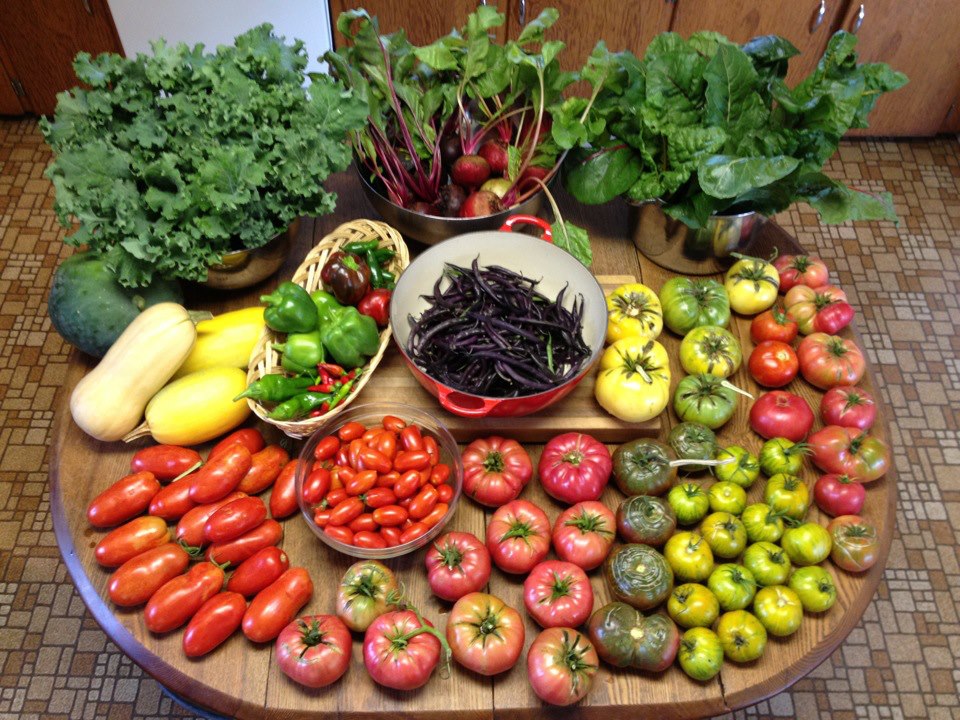
Emma Acres produce

Lord, how I wish my father had lived long enough to experience the whole pasture-raised, grass-fed, know-your-farmer movement.  Ralph Neely was a man who knew good meat, knowledge nurtured in the family-owned butcher shops he sought out and supported in big cities like Cleveland and small towns like Stockbridge, Michigan.

Memories of my dad spring to mind unbidden after an hour spent touring Emma Acres and buying meat  from farmer Mark Skowronksi.  Emma Acres is located at 9221 Waters Rd. a mile west of Parker Rd. in Washtenaw County.  If you’re headed west on Waters and come to the one lane bridge you’ve just passed it on the left.  There’s not much of a website yet – Mark and his wife no doubt too busy farming – but they are on Facebook at http://www.facebook.com/#!/emmaacres.farm .

One could not be more gracious than Mark and his young daughter Emerson but Emma the Farm Dog tried.  Emma insisted that Daisy the Terrier  – who accompanied me to the farm along with her brother, Casey the Shih Tzu  – join her on a never-ending series of full-speed gallops around the 80-acre property.

I was amazed when eventually Casey, who most emphatically does NOT socialize with other dogs and descends from ancestors bred to do nothing more than sit by an Emperor’s throne and appear aloof, was won over by Emma’s insistent hospitality and climbed out of the truck to grace the others with his imperial presence.

I bought an assortment of pastured broilers, lamb and pork along with smoked kielbasa and chorizo.  Mark raises two breeds of pigs, although he’s moving toward raising only the heritage breed known as Large Black Hogs; that really is the breed’s name!  I was scared when Daisy the Terrier followed Emma the Farm Dog into the hog pen  – didn’t Anthony Hopkin’s character feed someone to the hogs in “Hannibal”? – but everything turned out alright.  Take a look at the Large Black Hogs from Emma Acres and a scene from a Concentrated Animal Feed Operations (CAFO)somewhere in our nation’s heartland.  Which pork would you rather eat?

Hogs finished off in a CAFO, coming to a grocery store near you soon.

The night after my visit Linda and I had our best meal of the fall: a Emma Acres broiler with tiny Brussels Sprouts purchased at the Farmers’ Market and fingerling potatoes dug up at White Lotus Farms before they closed for the season.  http://www.whitelotusfarms.com/

Not everyone can afford to buy everything locally; Emma Acres meat prices are on par with Whole Foods prices.   For reasons of taste, the environment and the nurturing of my soul  I think my purchase was a bargain but I’ll guarantee you I wasn’t laying out $4.25 a pound for chicken when my kids were young and eating everything in sight.  Similarly there are consumers on fixed incomes or who are not mobile enough to visit farmers’ markets or places like Emma Acres.

But I’m convinced we could make a tremendous change in the safety of our food supply and the health of our nation if those who could, would.

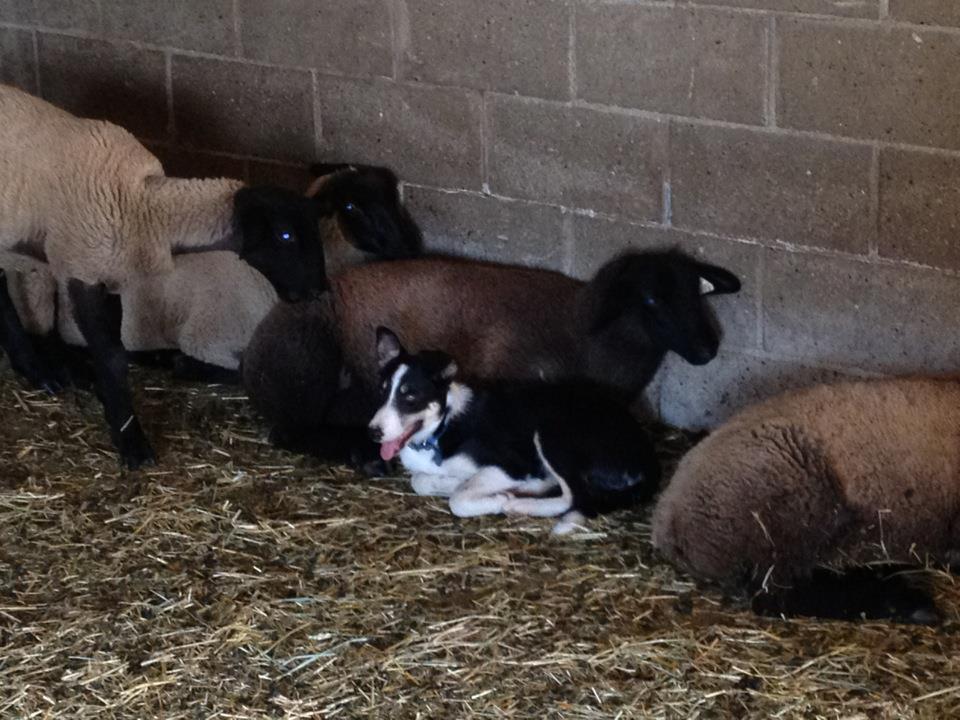
Emma the Farm Dog, the Hostess with the Mostess, watching over her flock by night.

Posted in Uncategorized | Tagged , , , , , , , , , , , | Leave a comment

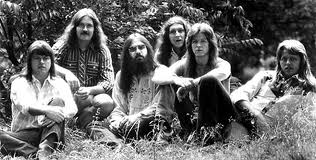
AND A NEW LIFE IS GONNA’ BE MINE (Thank you, Marshall Tucker Band; haven’t heard that song in ages)

Back in the summer of 1977 my former father-in-law told me there’s nothing really difficult about business.  George knew business and his words stuck with me.

“You’ve got an apple tree in your backyard, see, and you need to sell the apples you grow for more than it cost you to grow them.  That’s all there is to it.”

I recall these words at a time when I need to make changes in my employment.  I manage the wine, beer and liquor departments for a large, upscale retail store.  I am very good at what I do, overseeing consistent sales growth and profits, introducing successful new products and charming the heck out of a whole lot of satisfied, repeat customers.

The problem is I no longer drink.  Wine was once my passion and I held my own discussing – and consuming – beer and liquor.  But I no longer drink.  Let that statement suffice for now.

“So what?” you ask.  “You don’t need to drink booze in order to sell it.”

“Fair enough,” I respond, “but I am likely to work another ten years and I need to have at least some passion for what I do.  Sure, I’ve got enough knowledge stored up to fake it for a decade but it would be kinder if you would just shoot me now.  Thank you in advance and please don’t lose a minute’s sleep over this; you’re doing me a huge favor.”

“Are there no opportunities for promotion within the company you currently work for, something that doesn’t involve booze?”

“Maybe, but it seems that when one reaches a certain age he or she is pigeon-holed.  Employers appear to think older employees are heading placidly for the warm milking barn that was once a comfortable retirement rather than still striving for the top.  I hear this from my co-workers and observe it myself.  One day we show up to find one of our younger colleagues promoted and we never knew there was an opening.”

“Now that’s kind of ironic,” you smugly proclaim, “a Baby Boomer whining about a lack of opportunity.  You guys have been calling the shots for a couple of decades.”

“That’s fair, too.  But there’s been a fundamental shift since the crash of 2008.  You’ve now got educated Baby Boomers competing for lower-paying jobs previously held by younger, dare I say uneducated, workers.  It will be the wise employer who acknowledges this change and takes advantage of it.  An employee who once dreamed of fishing in Florida next winter might now give an employer 5 – 10 additional years of inspired, dedicated employment . . . I see you’re getting angry; what’s wrong?”

“All hail the pampered Baby Boomers; is that it?  You’ve had your way forever and now you want to hold back Generations X, Y and Z?”

“I can see how it might look that way but you’ll just have to take my word for the fact that I’m well-intentioned while I muddle through this predicament. Throw ‘em all in together and let the cream rise, that’s what I advocate.  If a 27-year-old kicks my butt all power to him or her, but give me a chance to win, too.”

“OK, OK . . . Jesus, my head’s about to explode.  Weren’t you talking about growing apples or some damn thing?  What was that all about?”

“Thanks for bringing me back on point.  In my perfect world I’d have a small, successful business of my own.”

“What’s holding you back?”

“Nothing.  I mean, I don’t have money for a large capital investment or the technical knowledge to implement a stunning breakthrough in engineering, but it occurs to me I ought to be able to sell an apple for more than it cost me to grow it.”

“You want to sell apples?”

“Stop being so literal, for crying out loud!  That’s one of the problems with your generation.”

“OK, OK . . . what, then?”

“I’ve been in business for myself in the past and have come to accept my strengths and weaknesses.  I’m a good general manager and creative as all-get-out.  I’m not good at keeping track of how much it costs to grow an apple.”

“How are you going to get around that?”

“I’m not sure yet.  I’m still in the early innings with this whole thing.”

“If not apples, then what?”

“Maybe tee-shirts.”

“Tee-shirts, you say?  Why tee-shirts?”

“What could be less technical?  What simpler business model than well-made tee-shirts with catchy slogans selling for 20% more than they cost to produce?  I think I can turn a $16 tee-shirt into $19.99 plus shipping and handling all day long.  Heck, that’s 25%.”

“I hate to admit it but you just might have something there.  People like those damn tee-shirts; don’t they?  You know, I saw one the other day that said . . . “

Check out the Marshall Tucker Band performing ‘A New Life’ from 1974 here: http://www.youtube.com/watch?v=zWqPwVmXOJg

Posted in Uncategorized | Tagged , , , , | 2 Comments

EAT WHAT I SAY, NOT WHAT I ATE: Recipes and Culinary Survival Strategies of my Youth

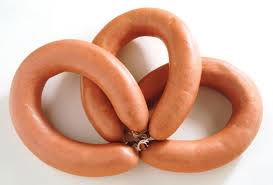
Two more links of ring bologna and we've got the Olympic symbol, or turn it upside down for a ring bologna heart!

At any given time I’ve got several ideas for a book floating around my mind.  Recently I’ve been trying to flesh out a book of recipes and observations centered around what those of us growing up as white, middle-class baby boomers ate from roughly 1955 – 1975, the first 20 years of my life.

 A good working title is “Eat What I Say, Not What I Ate: Recipes and Culinary Survival Strategies of My Youth”.  Yes, I know it’s too long; that’s why it’s called a ‘working title’.

Green salads were a wedge of iceburg lettuce covered with Thousand Island or French dressing, Blue (not Bleu) Cheese being too expensive in my home.  Romaine lettuce existed only in fancy restaurants as part of a Caesar Salad and mixed greens were still somewhere over the culinary horizon.  Chicory was occasionally found in fancy coffee and maybe our Italian neighbors knew about arugula but we surely did not.

Jello – and I know I’m supposed to write Jell-O® or gelatin but the hell with it – made up a whole salad classification which no longer exists.  Plain Jello, Jello surrounding cut up fruit from a can (pears being my favorite), and  Jello somehow blended with Cool Whip for holidays.

A holiday dish containing three major food groups: Jello, canned peaches and Cool Whip.

Jello, I’m convinced, was a key component of the white middle class’s culinary and financial survival strategy.  In my household we weren’t rich and during significant stretches were closer to lower- than to upper-middle class status.  Jello was cheap, it looked nice, kids would eat it.  What more could any parent ask for?

Cholesterol concerns?  Nah; at least not until the end of that era.  Ring Bologna and Calves Liver were served regularly and just as filling as more expensive meat dishes.  I hated calves liver but always had to try at least a few bites – drowning it in catsup increased its tolerability – and now I’ll occasionally order it when out to dinner.  Go figure.  Parents cared a lot less about whether or not their kids liked a particular dish in those days, the operative philosophy being something like, “Here’s some food; don’t eat it if you don’t want to but that’s all there is.”  We usually ate enough to get through the night – there was always Jello – and our parents weren’t heartless: dads were known to look the other way while moms slipped us a small bowl of cereal or a piece of peanut butter toast before bedtime on Calves Liver Night.

Finally there was the casserole, another largely-disappeared food group now found almost solely at church potlucks.  Provided by the blue-haired widows of the congregation, there is the very real danger that the casserole recipes of my youth will be lost forever once my parents’ generation is gone.

Let us sing the praises of the casserole.  Casseroles are the perfect vehicle for using left-overs; indeed, casseroles can stretch left-overs into even more left-overs.  Casseroles are inexpensive, an important middle-class culinary survival strategy.

Most importantly, casseroles provided the balanced nutrition so vital to our intellectual and physical development.  I still marvel that one dish could provide so many servings from the basic food groups: 1 can Campbell’s Mushroom Soup (Sodium), 2 cups cubed Velveeta (Saturated Fats), French’s Shoe String Potato Sticks (Hydrogenated Oils), etc.

There was often no telling what lay beneath a casserole's cheesy exterior.

I could go on about the cuisine of my youth, but now I’d like to hear from my readers . . . both of them.  What dishes do you remember with fondness, and which with disdain?  And remember, kids: eat what I say, not what I ate.

Posted in Uncategorized | Tagged , , , , , | 3 Comments